
Studio
Bright Studio
Red light. Full body. Glow.
Full-body red and near-infrared light, in twenty quiet minutes.
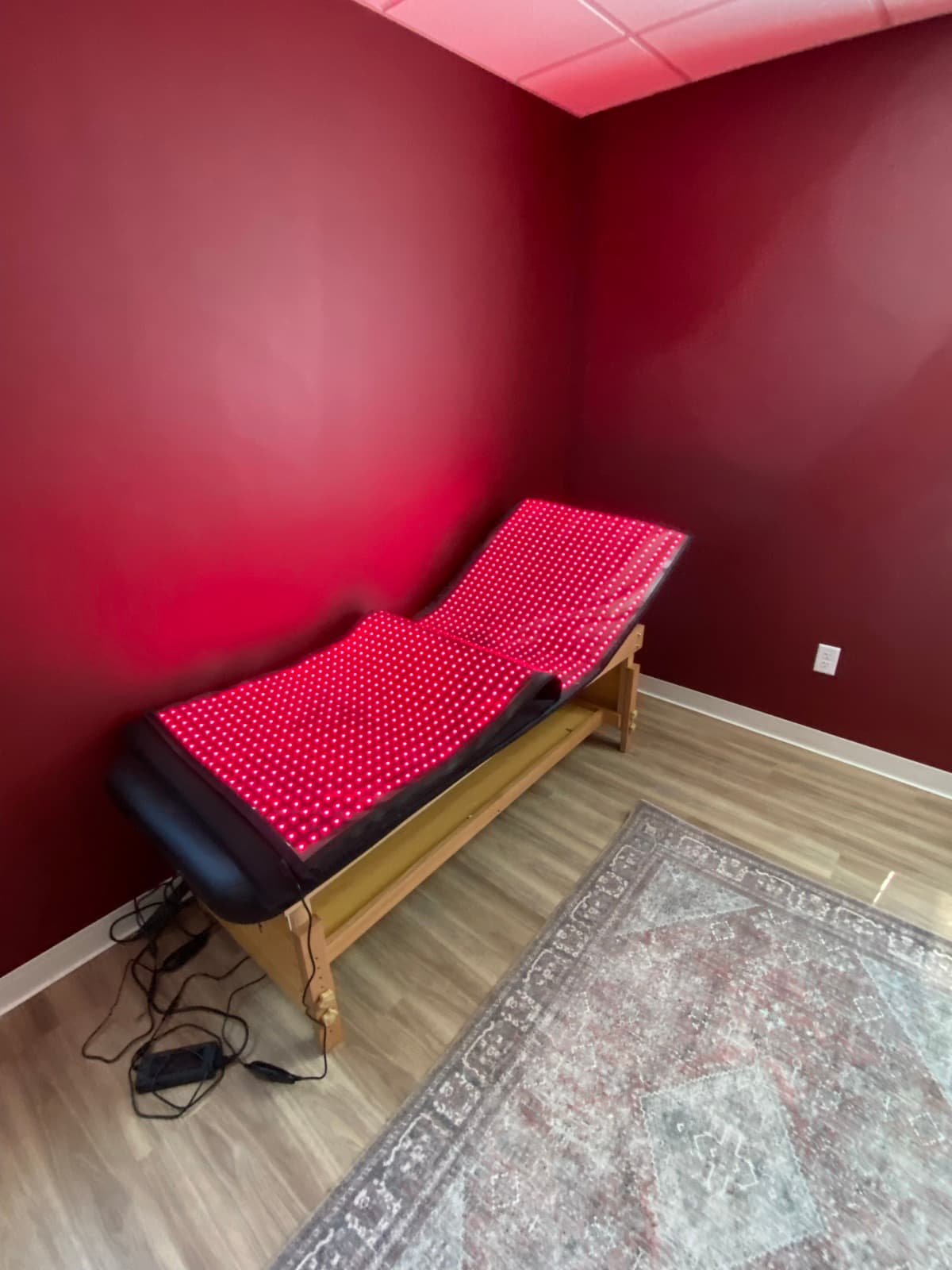
Bright Studio is built around one beautifully simple experience: full-body Red Light Blanket Therapy. You climb under a wrap-around panel of medical-grade LEDs that emit red light at roughly 660nm and near-infrared light at roughly 850nm, the two wavelengths most studied for skin and recovery. Twenty minutes, head to toe, no sweat and no noise.
The room is private, dim, and quiet. The blanket is warm but not hot. You'll feel a gentle, sun-on-your-face calm while the light does its work, and most members tell us they leave looking a little brighter and feeling a little lighter than when they arrived.
Tone, texture, and a healthy radiance, red and near-infrared light are the most-studied wavelengths for skin support.
Sore muscles, training loads, weekend warrior aches, photobiomodulation is a gentle, full-body recovery tool.
A bright, warm session in the middle of a gray New England day, members often describe a quiet lift afterward.
Unlike blue light, red and near-infrared don't suppress melatonin, a calmer wind-down option in the evenings.
- Photobiomodulation, in plain English. Specific wavelengths of red and near-infrared light are absorbed by mitochondria, the energy producers inside your cells, and appear to support cellular energy production and recovery. Harvard Health and the American Academy of Dermatology both describe this as a real and growing area of clinical research.
- Two wavelengths, two depths. Red light around 660nm is absorbed at the skin's surface and is the most-studied wavelength for tone, texture, and visible radiance. Near-infrared around 850nm penetrates deeper into muscle and joint tissue, that's the recovery side of the session.
- Full-body, not spot treatment. A wrap-around LED panel covers the whole body in one session. You don't have to choose between treating your face or your shoulders, you get both, in twenty minutes.
- Quiet, comfortable, repeatable. No sweat, no shock, no recovery time. The session is calm enough to do mid-day, evening, or after a workout, and consistency is what the research points to as the meaningful variable.
For the first 4–6 weeks. Research on red light is consistent on one thing: frequency matters more than session length.
Ongoing maintenance for skin tone and steady, low-effort recovery support.
If you're training hard or pushing volume, layer Bright in after your sessions.
Typical flow: Eye protection on → 20 minutes under the full-body blanket → step out, get dressed, get on with your day. No shower needed, no downtime. The sweet spot is consistency, not intensity.
Approach with care if you have:
None of these are off-limits, our team will walk you through a personalized routine during your consultation. If anything below sounds like you, mention it on your visit.
- ·Diagnosed photosensitivity or a light-sensitive skin condition
- ·Lupus or other photo-aggravated autoimmune conditions
- ·Medications that increase light sensitivity (some antibiotics, retinoids, and acne treatments)
- ·Recent eye surgery or active eye conditions
- ·Active skin cancer or undiagnosed lesions
- ·Pregnancy, unless cleared by your provider
- ·History of seizure disorder
📚 Full bibliography, 7 science-backed sources›
Medical Institutions
Clinical Evidence, Skin
- Medicine, Baltimore (2025), Randomized, double-blind, sham-controlled RCT of a 630nm/850nm LED+IRED device: significant improvement in periocular wrinkles vs. sham.
- J. Lasers in Medical Sciences (2025), Comprehensive review of human skin responses to different wavelengths of light: red and near-infrared collagen synthesis and skin rejuvenation.
Clinical Evidence, Recovery & Mechanism
Sleep & Circadian Reference
Photobiomodulation is an active and growing research area. This bibliography is reviewed and refreshed quarterly, see the next refresh window in our process documentation.
Where to start
Come and try Bright Studio.
A Day Pass is one visit, no membership and no commitment. Or begin with a Wellness Snapshot and we will tell you where you actually stand before you decide anything.
Recharge Wellness Club · Danvers, MA