
Studio
Brain Studio
Calm mind. Clearer thinking.
An evening session helps quiet a racing mind and ease the transition into a sleep-ready state.
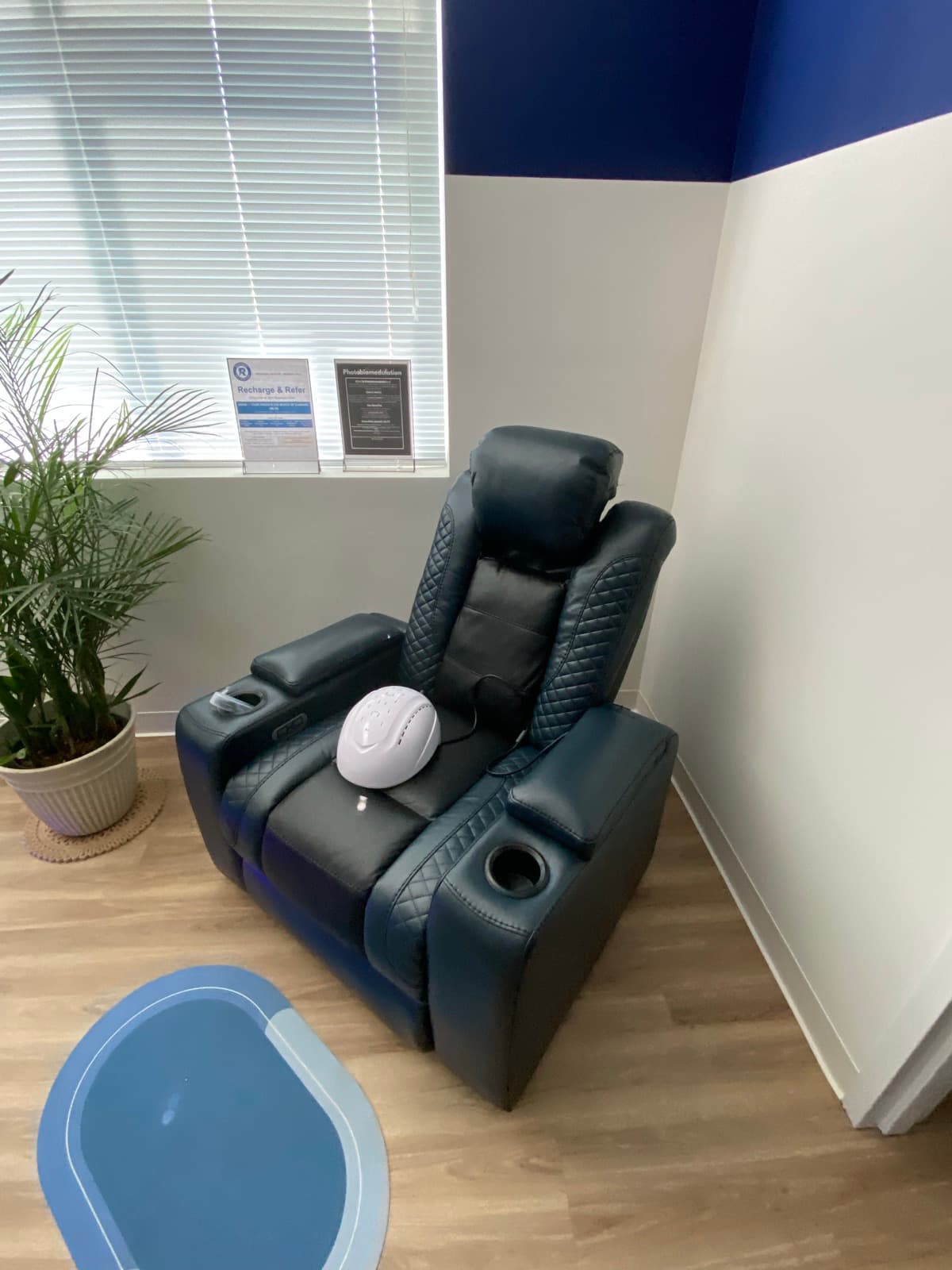
Brain Studio pairs two of the most evidence-supported, non-pharmacologic tools for a calmer head into one private session: the Calm Brain Light Helmet delivers transcranial near-infrared light, a technique known in the literature as photobiomodulation, and Calm Brain Stimulation uses a low, gentle current at the temples, an FDA-cleared modality known as cranial electrotherapy stimulation, or CES.
The session itself is uneventful in the best possible way: a quiet room, a comfortable seat, and twenty or so minutes of near-infrared light and a barely-perceptible current. Most guests leave feeling steadier, focus a little easier to find, the day a little less loud.
An evening session helps quiet a racing mind and ease the transition into a sleep-ready state.
For the days that demand a clearer head, preparing for deep work, study, or a high-stakes meeting.
Wired-and-tired weeks, overthinking, anxious energy, Brain Studio is built to downshift the system.
A repeatable, non-pharmacologic practice to support steadier mood alongside the rest of your routine.
- Near-infrared light reaches the brain. Transcranial photobiomodulation, the mechanism behind the Calm Brain Light Helmet, uses specific wavelengths of near-infrared light that can penetrate the skull and interact with mitochondria in cortical tissue, a pathway documented in peer-reviewed systematic reviews of the technique.
- CES is FDA-cleared for anxiety, insomnia, and depression. Cranial electrotherapy stimulation devices have been cleared by the U.S. Food and Drug Administration for the treatment of anxiety, insomnia, and depression, Calm Brain Stimulation uses the same modality.
- Evidence for anxiety and depression symptoms. Peer-reviewed systematic reviews indexed on PubMed find consistent, modest improvements in anxiety and depressive symptoms across CES and photobiomodulation trials, not a replacement for clinical care, but a meaningful non-pharmacologic adjunct.
- Calm, repeatable, drug-free. Both modalities are non-invasive, well-tolerated, and designed to be done on a regular cadence, the value compounds with consistency rather than dose.
For the first 3–4 weeks, while your nervous system learns the routine. Most research protocols cluster sessions early.
Ongoing rhythm, enough to keep the calm and focus benefits steady without dominating your week.
When sleep, deadlines, or anxious energy spike, short of daily, but more frequent for a stretch.
Typical flow: Calm Brain Light Helmet 20 minutes → Calm Brain Stimulation 20 minutes (or run them concurrently). Either service stands on its own; the pairing is where the studio earns its name. The sweet spot is consistency, not intensity.
Approach with care if you have:
None of these are off-limits in conversation, but several are firm "not today" items for the studio. Our team will walk you through a personalized routine during your consultation. If anything below sounds like you, mention it on your visit so we can plan around it.
- ·Seizure disorder or history of seizures
- ·Pacemaker or implanted electronic device
- ·Severe or recent head injury
- ·Pregnancy, unless cleared by your provider
- ·Light sensitivity or photosensitive conditions
- ·Recent neurosurgery or cranial implants
- ·Active medication for a serious mental-health condition (coordinate with your provider)
📚 Full bibliography, 5 science-backed sources›
Medical Institutions
Photobiomodulation, Clinical Evidence
- Gaggi et al., Frontiers in Behavioral Neuroscience (2025), Transcranial photobiomodulation for sleep, wakefulness, and cognition: systematic review of mechanism (near-infrared light, cortical mitochondria, cerebral blood flow) and clinical evidence.
- Theranostics (2025), Photobiomodulation for depression: review of mechanism and clinical evidence in mood and anxiety.
Cranial Electrotherapy Stimulation, Clinical Evidence
Brain Studio combines two distinct modalities, photobiomodulation (light) and cranial electrotherapy stimulation (current). Citations are kept separated by modality above so each can be evaluated on its own evidence base. This bibliography is reviewed and refreshed quarterly, see the next refresh window in our process documentation.
Where to start
Come and try Brain Studio.
A Day Pass is one visit, no membership and no commitment. Or begin with a Wellness Snapshot and we will tell you where you actually stand before you decide anything.
Recharge Wellness Club · Danvers, MA