
Studio
Compression Studio
Lighter legs. Quieter body.
After hard training, races, or long runs, a passive way to flush the legs and reduce next-day soreness.
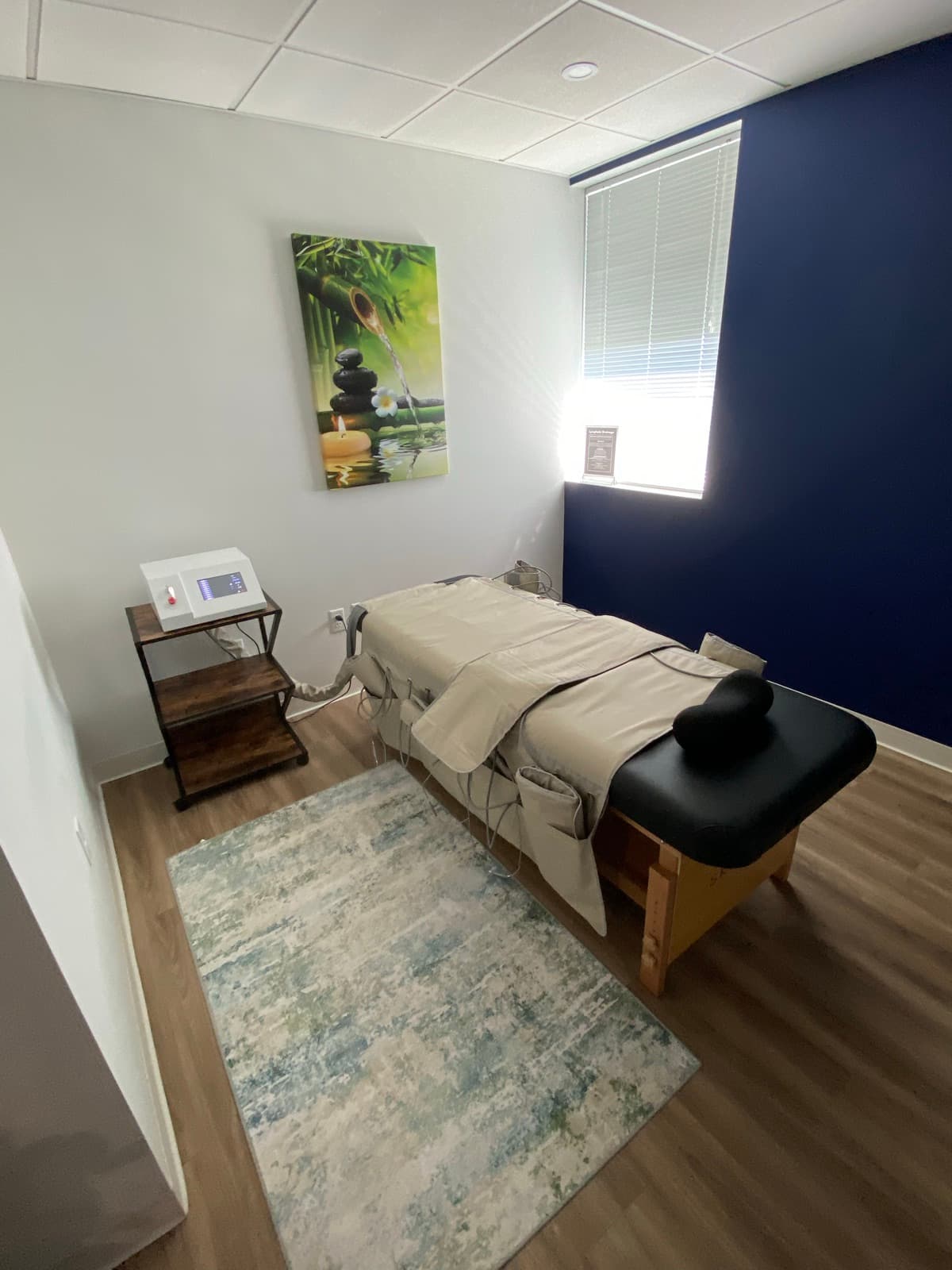
Compression Studio centers on pneumatic Lymphatic Drainage Compression, medical-style boots and sleeves that cover the legs and hips and inflate in carefully timed, segmented patterns. Each cycle gently pushes fluid upward through the circulatory and lymphatic systems, the same direction the body naturally moves it during walking, breathing, and muscle activity.
It's a recovery favorite among endurance athletes and lifters, and equally well-suited to the rest of life, long workdays spent sitting, days after travel, premenstrual heaviness, or any session where the legs simply feel full and tight. You lie back, the boots do the work, and most people leave noticeably lighter than they arrived.
After hard training, races, or long runs, a passive way to flush the legs and reduce next-day soreness.
For legs that feel full, puffy, or tight at the end of a long day, including premenstrual heaviness and hot-weather swell.
For sedentary stretches and desk-bound weeks, a rhythmic, mechanical assist for venous and lymphatic flow.
After flights, road trips, or long meetings on your feet, a quick way to drain and de-puff before the next day.
- Mechanical lymphatic assist. The lymphatic system has no central pump, it relies on muscle movement and external pressure to move fluid. Sequential pneumatic compression mimics that action, which is why it's a long-established clinical tool for lymphedema management.
- Venous return support. Segmented, distal-to-proximal inflation helps move venous blood back toward the heart, the same physiology behind compression stockings and DVT-prevention devices used in hospitals.
- Post-exercise recovery. A growing body of research on intermittent pneumatic compression in athletes points to reduced perceived soreness and faster return-to-feel after intense training, with a strong safety profile.
- Comfort that you'll actually use. Unlike a deep-tissue massage, compression is passive, you can read, rest, or close your eyes, which makes it one of the easier recovery tools to do consistently.
For the first 2–3 weeks, while you find the pressure setting and time slot that feel right.
Ongoing rhythm for general recovery, heaviness, and circulation support.
Race weeks, post-flight days, or heavy training blocks, short, frequent sessions outperform one long one.
Typical flow: Boots/sleeves on, recline 20–30 minutes through a full inflation/deflation program. The sweet spot is consistency, not intensity, modest pressure done often beats max pressure done rarely.
Approach with care if you have:
Compression therapy is well-tolerated by most adults, but a few conditions warrant a conversation first. If anything below sounds like you, please mention it at your consultation, our team will route you to the right approach.
- ·Known or suspected deep vein thrombosis (DVT)
- ·Severe peripheral artery disease (PAD)
- ·Active infection, cellulitis, or open wound on the limb
- ·Recent fracture or unstable orthopedic injury in the limb
- ·Severe peripheral neuropathy or loss of sensation
- ·Uncontrolled congestive heart failure
- ·Pregnancy, unless cleared by your provider
📚 Full bibliography, 9 science-backed sources›
Medical Institutions
Clinical Evidence, Lymphedema & Vascular
Clinical Evidence, Athletic Recovery
- Pinheiro et al., PMC (2024), Effects of lower-limb intermittent pneumatic compression on sports recovery: a systematic review and meta-analysis.
- Maia et al., PubMed (2025), IPC may reduce perceived muscle soreness following exercise-induced muscle damage: a randomized placebo-controlled trial.
- PubMed, Intermittent pneumatic compression and post-exercise recovery: literature on perceived soreness, performance metrics, and safety.
- PMC, Open-access reviews and trials on pneumatic compression in athletic populations.
Physiology Background
Sources here are curated to top-tier medical institutions and indexed clinical literature. PubMed and PMC search links are used in place of single-study citations when the relevant evidence base spans multiple trials. This bibliography is reviewed and refreshed quarterly, see the next refresh window in our process documentation.
Where to start
Come and try Compression Studio.
A Day Pass is one visit, no membership and no commitment. Or begin with a Wellness Snapshot and we will tell you where you actually stand before you decide anything.
Recharge Wellness Club · Danvers, MA