
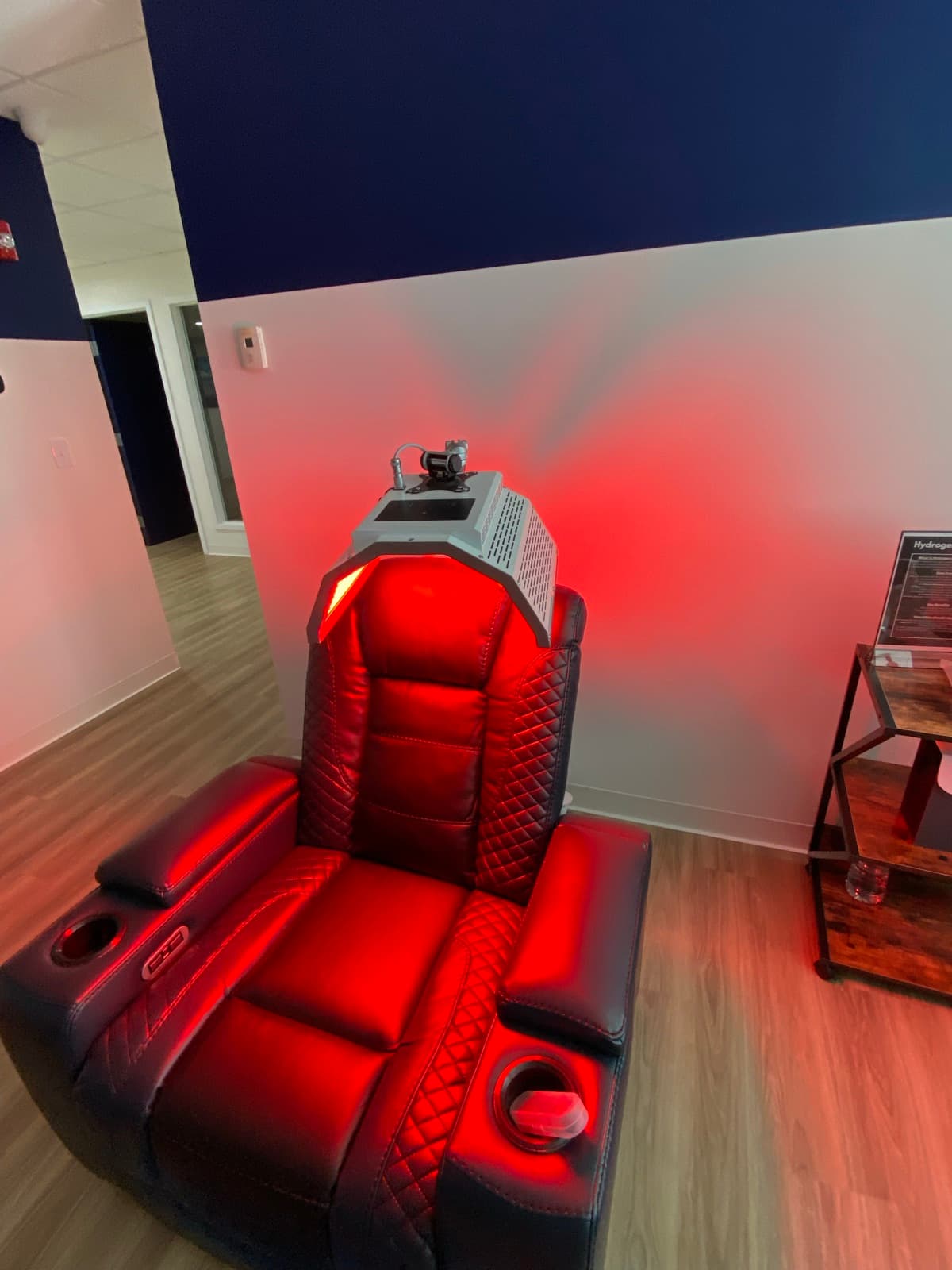
Studio
Facial Light Studio
Skin light therapy, in three wavelengths.
Red light supports collagen, evens tone, and gives the complexion that "well-rested" look, even when you aren't.
Facial Light Studio brings together three clinical light-based experiences in a single, private room, Blue, Red, and Infrared. Each wavelength sits in a range supported by peer-reviewed dermatology and photobiomodulation literature, and the studio is designed for members who want visible change in their skin without needles, downtime, or heat damage.
Each wavelength does a different job. Blue light targets the acne-causing bacteria that live at the skin surface. Red light works a layer deeper, supporting collagen, tone, and the "well-rested" look. Infrared penetrates further still, for deeper skin recovery, gentle warmth, and the calming, mood-lifting side of consistent light exposure. Stacked across a week, the three together become the studio's signature routine: clearer skin, softer lines, and a brighter baseline.
Red light supports collagen, evens tone, and gives the complexion that "well-rested" look, even when you aren't.
Blue light targets the bacteria that drive breakouts. A drug-free option for ongoing skin clarity.
Photobiomodulation supports fine-line softening, firmness, and resilience, gradually, with consistent visits.
Consistent bright-light exposure is widely studied for mood, energy, and circadian rhythm, especially helpful through the New England winter.
- Blue light, targeted at acne bacteria. Blue light (around 415nm) excites porphyrins produced by Cutibacterium acnes, the bacteria implicated in inflammatory acne, a drug-free mechanism noted by Mayo Clinic and Cleveland Clinic as an option for mild-to-moderate acne.
- Red light for collagen and tone. Red light (~630–660nm) is absorbed by mitochondria in skin cells, supporting cellular energy (ATP) and collagen synthesis, the mechanism behind photobiomodulation's effects on glow, firmness, and fine-line softening.
- Infrared for deeper skin recovery. Near-infrared wavelengths (~810–880nm) penetrate beyond the surface to support local circulation and tissue recovery, and add the gentle warmth that makes a session feel restorative.
- Drug-free, downtime-free, repeatable. Light therapy has no needles, no heat damage, and no recovery time, which is what makes a weekly cadence realistic for skin outcomes that depend on consistency.
For the first 4–6 weeks, while collagen, skin clarity, and circulation respond to the wavelengths.
Ongoing maintenance, enough to hold the gains in glow, firmness, and clarity.
A steady winter cadence for the bright-light, mood-supporting side of consistent exposure.
Typical session: 20–30 minutes under the panel, eye protection provided, no downtime. Stack wavelengths across visits, blue one day, red the next, infrared on a recovery day, or focus a full cycle on a single goal.
Approach with care if you have:
None of these are off-limits, our team will walk you through a personalized routine during your consultation. If anything below sounds like you, mention it on your visit. Eye protection is provided and required for every session.
- ·Photosensitivity or a history of light-triggered reactions
- ·Lupus or other photosensitive autoimmune conditions
- ·Photosensitizing medications (some antibiotics, diuretics, isotretinoin)
- ·Recent retinoid use (Retin-A, tretinoin, prescription strength)
- ·Pregnancy, unless cleared by your provider
- ·Recent eye surgery or active eye conditions
- ·Open wounds or active skin infection on the face
- ·Undiagnosed lesions on the face, see your dermatologist first
📚 Full bibliography, 5 science-backed sources›
Blue Light, Acne
- J Cutan Med Surg (2024), Visible light in the treatment of acne vulgaris: systematic review of 35 studies (1,185 cases); blue light (407–420nm) exerts a bactericidal effect on Cutibacterium acnes.
- J Clin Aesthet Dermatol (2025), Open-label clinical study of combined 415nm/633nm phototherapy for mild-to-moderate acne: significant reductions in inflammatory and noninflammatory lesions.
Red Light, Collagen & Skin Tone
Near-Infrared, Deeper Skin Recovery
Every source above is a primary medical institution, FDA filing, or peer-reviewed paper. This bibliography is reviewed and refreshed quarterly, see the next refresh window in our process documentation.
Where to start
Come and try Facial Light Studio.
A Day Pass is one visit, no membership and no commitment. Or begin with a Wellness Snapshot and we will tell you where you actually stand before you decide anything.
Recharge Wellness Club · Danvers, MA