
Studio
Sound Studio
Sound you feel. Nervous system, quiet.
For wired-and-tired days. Low-frequency vibration helps the body let go without requiring you to "try" to relax.
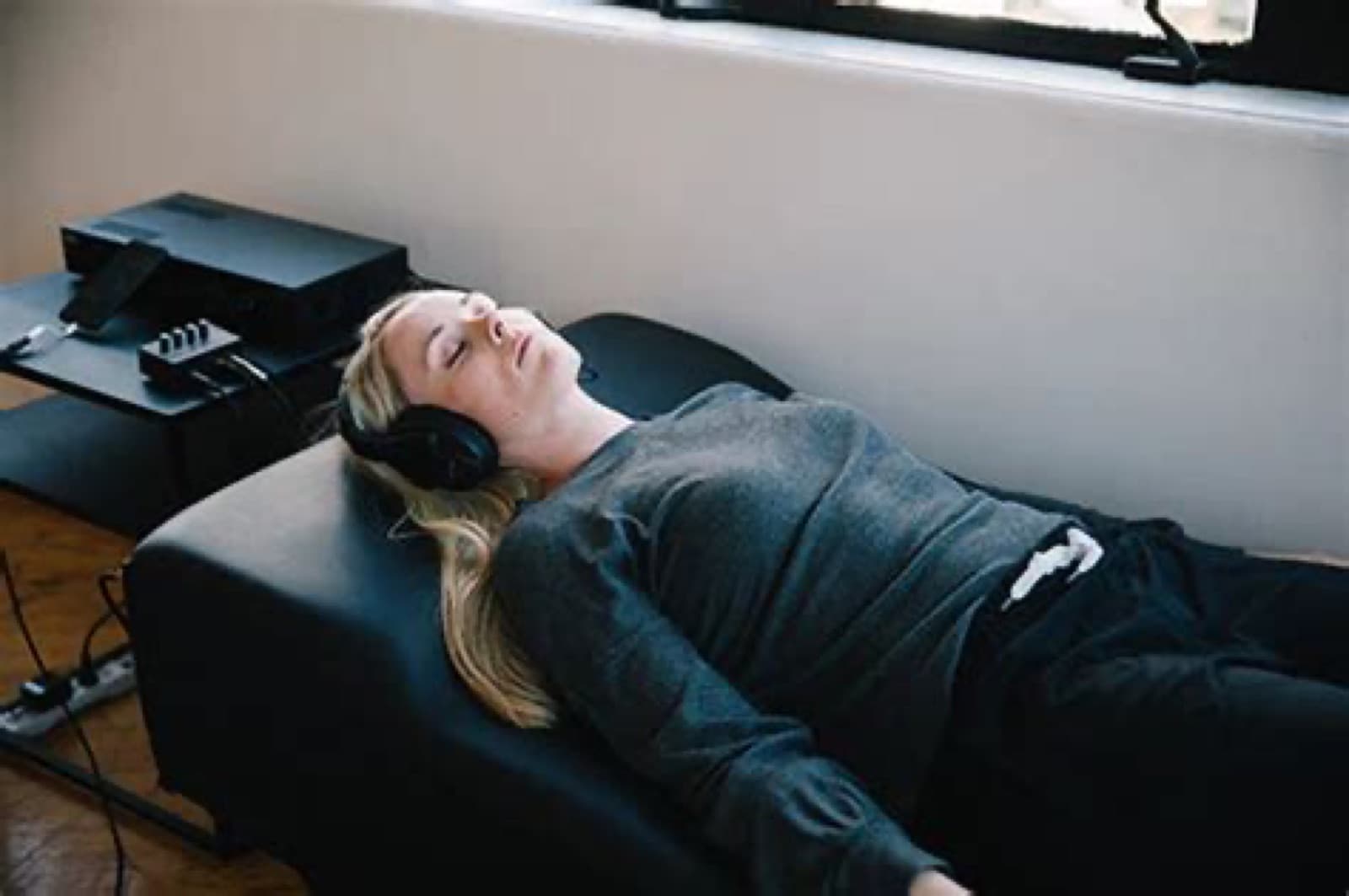
Sound Studio is built around one experience: Vibroacoustic Sound Bed Therapy. You lie down on a bed embedded with low-frequency transducers, breathe, and feel curated low-frequency music move through your body, not just heard through the ears, but felt in your bones. The vibration is gentle, musical, and steady; the room is dim and still.
The intent is simple: drop quickly into a parasympathetic ("rest and digest") state and stay there long enough for the body to recalibrate. Vibroacoustic therapy has earned a place in sleep, stress, and recovery routines because it works without effort, no breathwork to learn, no posture to hold, no mental task to perform. You arrive, you settle in, and the bed does the work.
For wired-and-tired days. Low-frequency vibration helps the body let go without requiring you to "try" to relax.
An evening session helps shift the body out of alertness and toward a deeper, easier night of sleep.
A quiet, passive way to quiet a busy nervous system, well-suited to people who find seated meditation difficult.
Members report a clearer head and steadier mood in the hours that follow, a calmer baseline to work from.
- Low-frequency vibration reaches the body, not just the ears. Vibroacoustic therapy delivers sound between roughly 30–120 Hz directly through the body via transducers, a mechanical, tactile signal in addition to an auditory one.
- Parasympathetic shift. Peer-reviewed reviews of vibroacoustic and sound-based therapies report measurable reductions in stress, anxiety, and arousal, consistent with a shift toward "rest and digest" nervous-system tone.
- Sleep and pain support. Clinical literature, including work indexed at PubMed Central, documents vibroacoustic therapy being studied for sleep quality, pain modulation, and rehabilitation alongside standard care.
- Sound therapy, broadly. Recent peer-reviewed meta-analyses describe music and sound-based interventions as a credible, low-risk complement to conventional care for stress, anxiety, sleep, and mood, the same family Vibroacoustic therapy belongs to.
For the first 2–3 weeks, while your body learns the sensation and your nervous system builds the response.
Ongoing rhythm for stress, sleep, and mood support, most members settle here.
Vibroacoustic sessions are passive and low-load, safe to lean on during demanding stretches.
Typical flow: Arrive a few minutes early, settle onto the bed, breathe and let the program play (about 30 minutes). Most members feel the shift inside the first ten minutes. The sweet spot is consistency, not intensity.
Approach with care if you have:
None of these are automatic disqualifiers, our team will walk you through a personalized routine during your consultation. If anything below sounds like you, mention it on your visit.
- ·Pacemaker or other implanted electronic medical device
- ·Severe or unstable psychiatric conditions (acute psychosis, PTSD flares)
- ·Pregnancy, unless cleared by your provider
- ·Active seizure disorder
- ·Recent surgery or unhealed fractures
- ·Severe vertigo or inner-ear conditions
- ·Deep vein thrombosis or acute thrombotic risk
📚 Full bibliography, 6 science-backed sources›
Clinical Evidence, Vibroacoustic Therapy
- Sensors / PMC (2024), Effects of vibroacoustic stimulation on psychological, physiological, and cognitive stress; documents parasympathetic activation via heart rate variability.
- Healthcare / PMC (2025), Mixed-methods pilot of vibroacoustic therapy on emotion regulation and attention; an example of the therapy being studied alongside standard care.
Sound, Music & Stress, Meta-Analyses
- Frontiers in Psychology / PMC (2026), Systematic review and meta-analysis of music interventions on heart rate variability, with significant increases in parasympathetic markers.
- eClinicalMedicine / PMC (2025), Systematic review with multilevel meta-analyses of music therapy for the treatment of anxiety across 51 studies.
Sleep & Nervous-System Context
- Frontiers in Neurology / PMC (2025), Meta-narrative review on music therapy and sleep: improvements in subjective sleep quality largely via mood and anxiety regulation.
- StatPearls / NCBI Bookshelf (2025), Background on the autonomic nervous system: parasympathetic ("rest and digest") tone and how it shifts in response to calming inputs.
Vibroacoustic therapy is an emerging-but-growing evidence base; we cite peer-reviewed reviews and major medical institutions only. This bibliography is reviewed and refreshed quarterly, see the next refresh window in our process documentation.
Where to start
Come and try Sound Studio.
A Day Pass is one visit, no membership and no commitment. Or begin with a Wellness Snapshot and we will tell you where you actually stand before you decide anything.
Recharge Wellness Club · Danvers, MA